AQUARIUS Funding Call – Marine and Freshwater Infrastructure Access: Open 02 September 2025 – 28 October 2025
AQUARIUS Funding Call – Marine and Freshwater Infrastructure Access: Open 02 September 2025 – 28 October 2025
Coastal seas are the hotspots in global marine carbon fluxes. They receive considerable amounts of organic carbon originating from terrestrial and freshwater systems through rivers and estuaries.



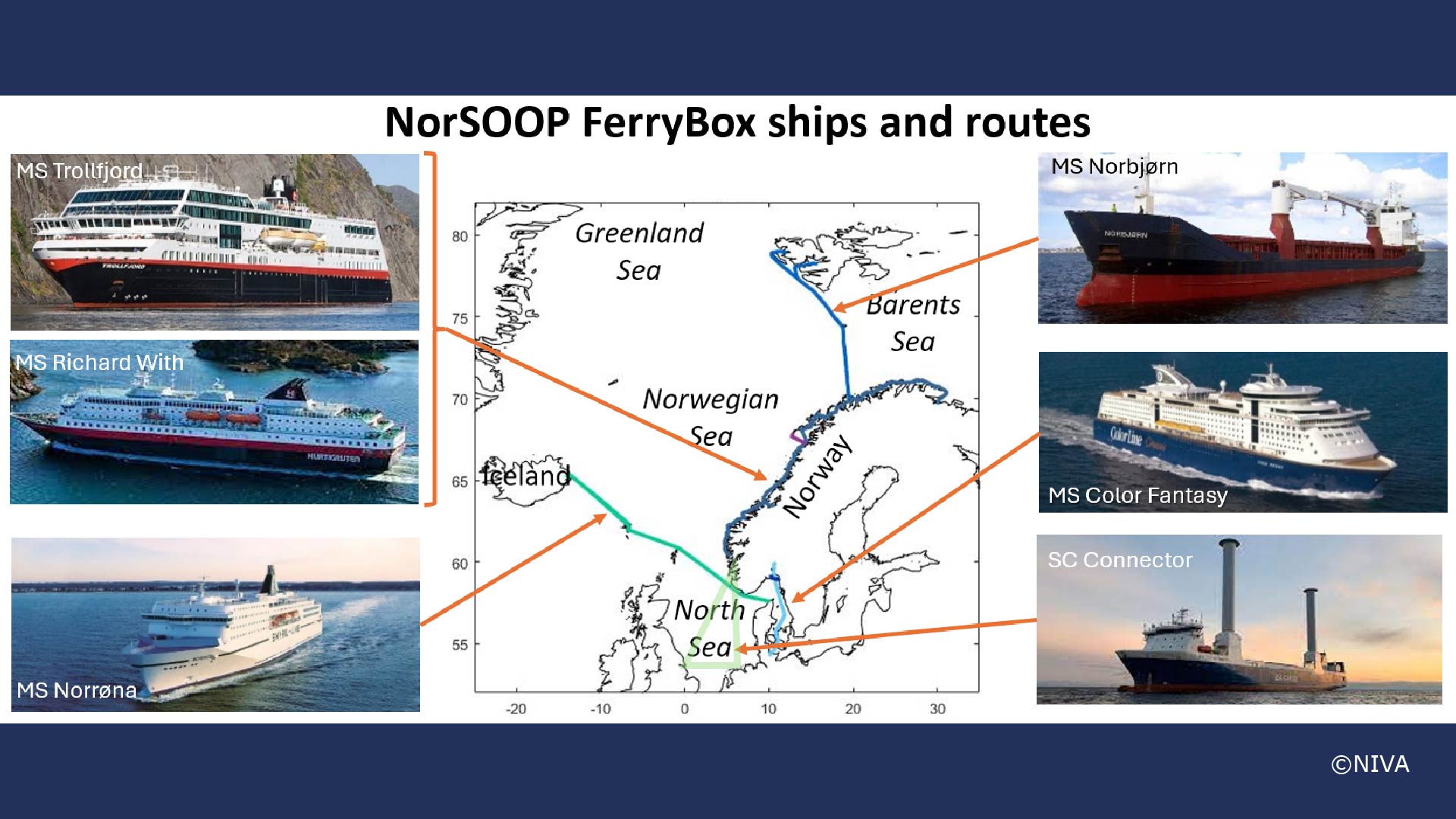

Research Infrastructure Used: MESO & CAL, Alg@line, NorSOOP
“The q-fDOM project has gathered a fantastic group of experts and users of fluorescence-based measurements of CDOM and will work towards harmonization of the commercially available fDOM fluorometers.”
Anna Willstrand Wranne, Voice of the Ocean Foundation
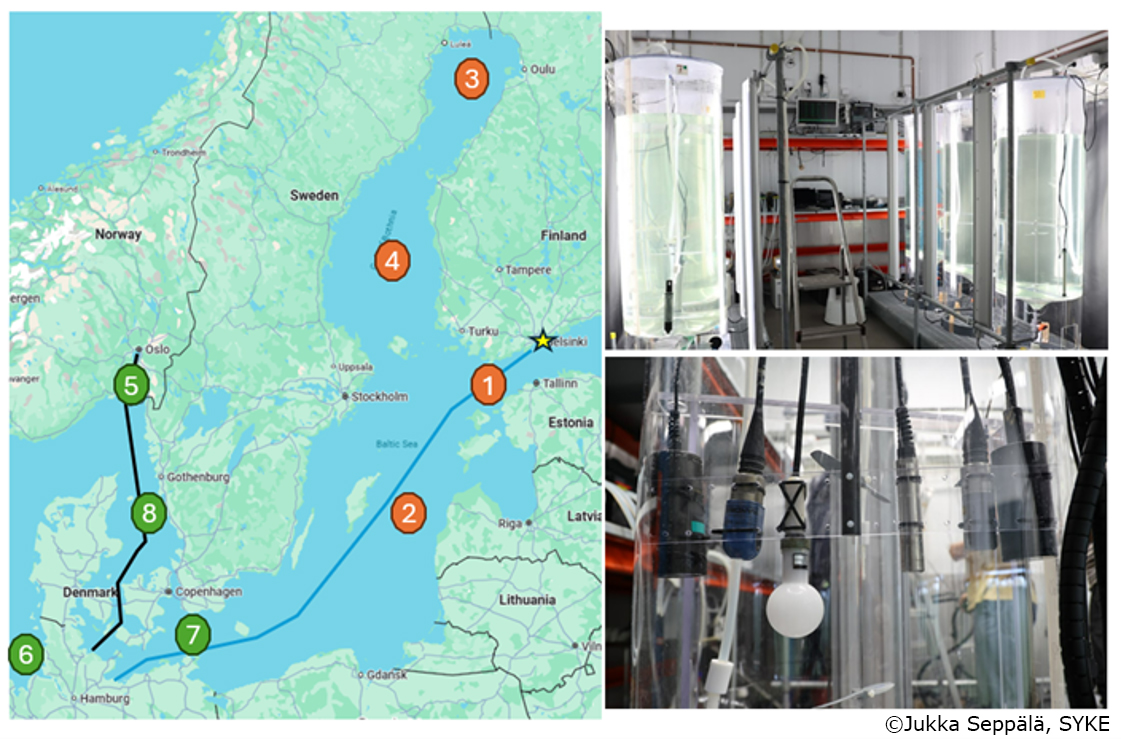
Coastal seas are the hotspots in global marine carbon fluxes (Dai et al 2022). They receive considerable amounts of organic carbon originating from terrestrial and freshwater systems through rivers and estuaries. Compared to the open ocean, coastal seas often have high biological activity, both in producing new organic matter through photosynthesis and in mineralising the existing organic matter pools. In coastal waters the increase of dissolved organic matter (DOM) causes brownification, a change in water colour and increase of light attenuation, affecting light availability for primary productivity. DOM also contains nutrients that may boost primary production or bacterial processes, and the labile carbon in DOM will induce mineralisation processes. Thus, DOM fluxes affect the aquatic metabolism and determine if the system is a source or sink of oxygen and carbon. Terrestrial carbon is also a key determinant of carbon budgets in many coastal systems and riverine inputs have affects the carbonate system (alkalinity, DIC, pH, pCO2). A high-quality pan-European monitoring network to study coastal carbon dynamics and transport of carbon from terrestrial systems to coastal seas and further to open ocean has been proposed by ICOS, Euro ARGO, and JERICO communities (Felgate et al 2020, Frigstad et al 2024).Optimally, such a monitoring system includes measurements of various carbon fractions, related carbonate system variables (TA, pH) and optical proxies for dissolved organic matter – coloured dissolved organic matter (CDOM), and the fraction of CDOM that fluoresces (fDOM) (Felgate et al 2020). The user group, including six partners doing Carbon-related research and monitoring in the Baltic Sea and North Sea, have the goal to harmonize and standardize fDOM measurements in order for harmonisation of methods and adoption of the best practices that is required to yield consistent data across the studied systems.
Main objectives:
Comprehensive experimental determination of fDOM temperature dependency for various sensors across the different water types and the determination of optical variations among sensors.
Partnership provides a wide range of coastal waters to be tested, using the available range of commercial sensors. Results will highlight if the obtained correction functions are “universal” or if there are differences between sensors (with different optics) and between water types (with different DOM quality). Additional information is gained on how the optical match-up between DOM spectral excitation-emissions properties and sensor spectral properties, and fluorescence re-absorption may affect the readings.
Test how consistent data various sensors provide across temperature and fDOM gradients, guiding developments towards harmonized sensor networks.
Long-term in situ tests, deploying several sensors simultaneously in Ferrybox systems, will reveal if consistent data is obtained after joint calibration of sensors (1) and after applying best available experimentally derived corrections for temperature and optics (2). Recommendations will be reported for build-up of Carbon monitoring networks, for fDOM sensor calibration, corrections and validation, and for sensor selection (see Section 7).
MORE INFORMATION
AQUARIUS TA Project Name:
Improving the quality of fluoresence based dissolved organic matter observations in coastal waters
Project acronym:
q-fDOM
TA Project Unique ID:
61
Partners involved:
• Voice of the Ocean Foundation
• OceanObs
• Swedish Meteorological and Hydrological Institute (SMHI)
• Leibniz-Institut für Ostseeforschung Warnemünde (IOW)
• Helmholz Zentrum Hereon
• Technical University of Denmark (DTU)
Start date
1 May 2026
End date
1 June 2027
Mission Lighthouse Region
Baltic & North Sea
Work/research geographical
area
North Sea and the Baltic Sea
Names of RI facilities used
• MESO & CAL
• Alg@line
• NorSOOP
Scientific discipline(s)
Earth Sciences & Environment: Marine science/Oceanography
Principal Investigator
(PI) Affiliation
Anna Willstrand Wranne