Skip to content Skip to footer

MED-AGREE

Consistent Mediterranean Sea inorganic chemistry: in situ Med-SHIP intercomparision exercise

Funded by AQUARIUS Transnational Access Call 2

The proposed research supports efforts to understand and monitor the rapid physical and biogeochemical transformations in the Mediterranean Sea, particularly those driven by climate-induced changes in circulation, deep-water formation, and carbon cycling.

Region of Operation: Western Basin, Tyrrhenian Sea and/or Ionian Sea maybe reaching the Cretan Sea. Mediterranean Sea

Research Infrastructure Used: RV Gaia Blu

“The MED-AGREE cruise will build upon previous Med-SHIP cruises, generating critical, high-quality datasets that improve our understanding of how the MedSea responds to multiple stressors, including warming, acidification, and deoxygenation. These insights support improved climate resilience, inform adaptation strategies, and guide sustainable management of the region’s marine resources. The outcomes of the MED-AGREE intercomparison exercise will have a significant impact in reducing uncertainty in key biogeochemical measurements. Enhanced data reproducibility will lessen reliance on secondary quality-control procedures that are otherwise required to detect systematic biases, a challenge particularly acute in the MedSea due to its rapid water turnout. As a result, the reliability and interoperability of biogeochemical datasets will improve and strengthen the observation-to-data-product value chain, and ultimately enhance the quality of regional assessments and modeling efforts. ” 

Marta Álvarez (IEO-CSIC)

PARTNERS

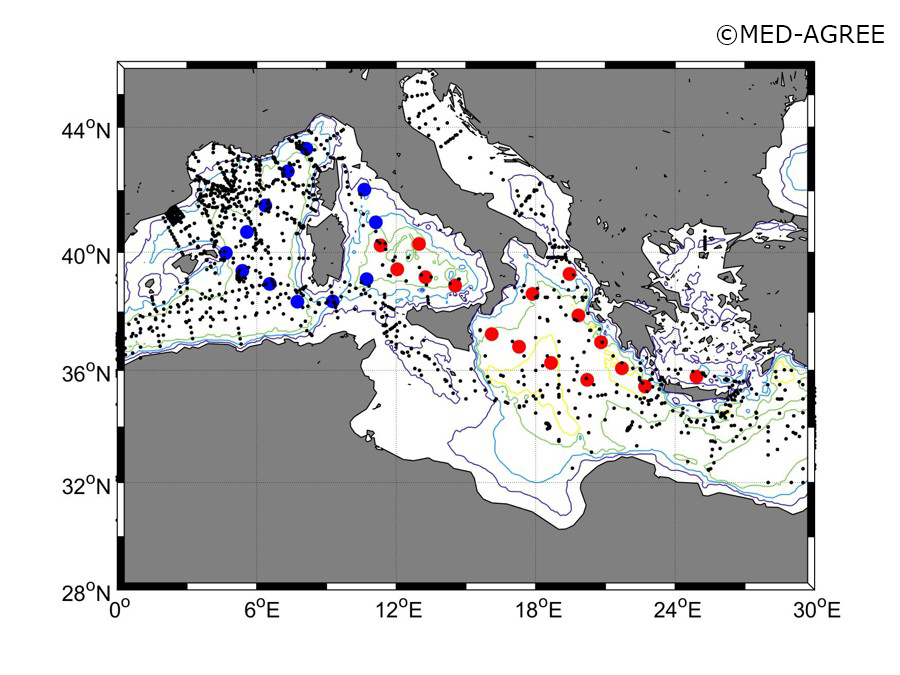
The map illustrates the initially proposed track (red points) alongside an alternative track (blue points). Black points indicate stations from previous Med-SHIP and other cruises included in the CARIMED compilation, providing a reference framework for time-series continuity and intercomparison.

MAIN OBJECTIVES

The proposed research supports efforts to understand and monitor the rapid physical and biogeochemical transformations in the Mediterranean Sea, particularly those driven by climate-induced changes in circulation, deep-water formation, and carbon cycling. Building on the Med-SHIP framework and the CARIMED data synthesis product, this project will generate high-quality, comparable data to fill key gaps in basin-wide dynamics and CO2 system variability. Specifically, the proposed work will:

  • Repeat selected Med-SHIP stations and integrate both new and existing cruise data through the CARIMED data synthesis product to evaluate the rapid evolution of the WMT in the Western and Tyrrhenian basins, as well as to track the progression of the EMT in the Ionian basin in relation to the inflow of newly formed deep waters from the Adriatic. These observations are essential to assess how physical circulation changes influence heat, carbon, and oxygen storage across the MedSea’s interconnected sub-basins. 
  • Conduct the first in situ intercomparison exercise in the MedSea for seawater CO2 system variables—pH, DIC, TA, and continuous surface pCO2 measurements. This pioneering effort will focus on minimizing sampling and preservation uncertainties and on enhancing QA/QC procedures through certified and in-house reference materials, harmonized best practices for both shipboard and shore-based replicate analyses.

The specific outputs and deliverables of the proposed work will include:

  • A catalog of metadata and harmonized, formatted, and quality-controlled dataset associated with the RV Gaia Blu (or RV Thalassa) cruise, covering both surface and full-depth water-column measurements. As noted, all datasets will comply with FAIR principles and be made publicly available through ocean data repositories.
  • An initial report will document the results of the in situ replicate analysis and intercomparison exercise, followed by complete metadata and datasets from participating laboratories. A peer-reviewed publication presenting these results is also anticipated. Submission of adapted best practices and SOPs for DO, pH, TA, DIC, and NUT measurements in the MedSea, emphasizing the use of in-house and certified reference materials and developing consensus end-to-end procedures from sampling to raw data processing.

MORE INFORMATION

AQUARIUS TA Project Name:

Consistent Mediterranean Sea inorganic chemistry: in situ Med-SHIP intercomparision exercise

Project acronym:

MED-AGREE

TA Project Unique ID:

84

Partners involved:

  • Instituto Español de Oceanografía, Consejo Superior de Investigaciones Científicas (IEO-CSIC)
  • Istituto di Scienze Marine del Consiglio Nazionale delle Ricerche (CNR-ISMAR)
  • GEOMAR Helmholtz Centre for Ocean
  • Laboratoire national de métrologie et d’essais (LNE)
  • Institut Pytheas / Institut Méditérranéen d’Océanologie (MIO)
  • National Oceanographic Centre (NOC);
  • National Institute of Oceanography and Applied Geophysics – OGS
  • METU Institute of Marine Sciences;
  • University of the Aegean
  • Sorbonne University Pierre and Marie Curie Campus, SNAPO-CO2
  • RBINS – OD NATURE – ECOCHEM
  • Institut National de Recherche Halieutique (INRH)
  • University of Florence
  • Agenzia nazionale per le nuove tecnologie, l’energia e lo sviluppo economico sostenibile (ENEA)

Start date

1 January 2027

End date

30 March 2028

Mission Lighthouse Region

Mediterranean Sea

Work/research geographical
area

Western Basin, Tyrrhenian Sea and/or Ionian Sea maybe reaching the Cretan Sea, it will depend on ship schedule.

Names of RI facilities used

RV Gaia Blu

Scientific discipline(s)

Earth Sciences & Environment: Marine science/Oceanography

Principal Investigator
(PI) Affiliation

Instituto Español de Oceanografía, Consejo Superior de Investigaciones Científicas (IEO-CSIC)