AQUARIUS Funding Call – Marine and Freshwater Infrastructure Access: Open 02 September 2025 – 28 October 2025
AQUARIUS Funding Call – Marine and Freshwater Infrastructure Access: Open 02 September 2025 – 28 October 2025
The GLOW project aims to improve our understanding of the links between underwater visibility and coastal–offshore interactions in the Baltic Sea.



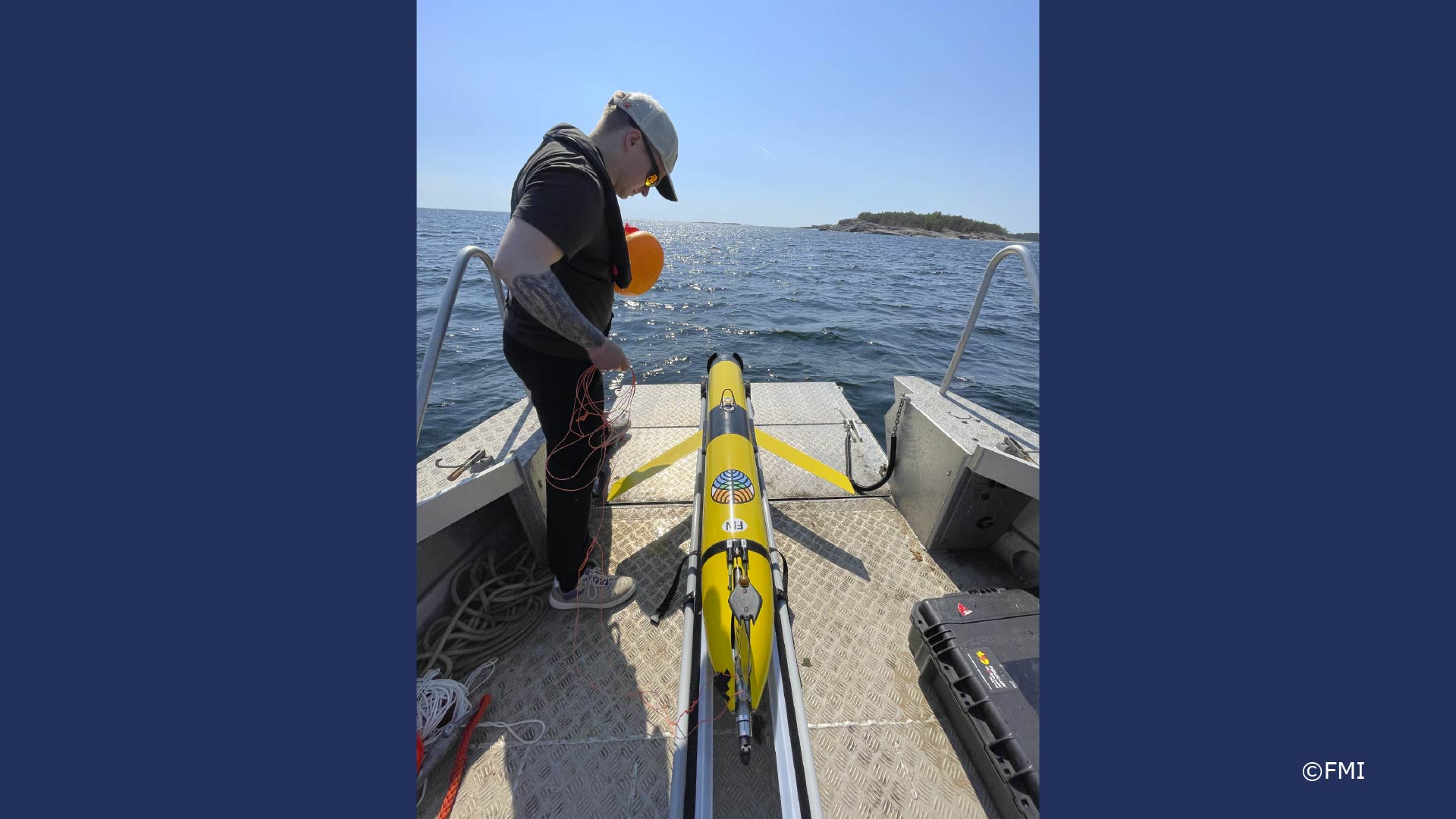
Research Infrastructure Used: Baltic Gliders
“Access to the AQUARIUS glider infrastructure allows us to extend and intensify our existing glider and mooring observations, providing high-resolution measurements over larger areas and longer time periods than we could achieve with our existing resources alone. This will help us better understand underwater visibility and coastal–offshore exchange processes in the Baltic Sea.”
Tavvi Liblik (Tallinn University of Technology)

The GLOW project aims to improve our understanding of the links between underwater visibility and coastal–offshore interactions in the Baltic Sea. Using autonomous underwater gliders equipped with multiple sensors, the project will collect high-resolution physical, chemical, and optical measurements between 2026 and 2027 across several Baltic Sea regions. These observations will enable the assessment of underwater visibility, particle dynamics, and water circulation processes, while providing essential baseline data to evaluate the impacts of climate change and human activities.
The main objectives are:
Investigate coastal–offshore exchange processes by quantifying how circulation, stratification, pycnocline dynamics, and mixing drive the transport of water masses between coastal and offshore regions.
Understand the coupling between physical dynamics and optical variability by determining how coastal–offshore exchanges redistribute optically active substances and shape underwater visibility across the Baltic Sea.
MORE INFORMATION
AQUARIUS TA Project Name:
Glider Observations of Light and Water Exchange in the Baltic Sea
Project acronym:
GLOW
TA Project Unique ID:
77
Partners involved:
• Tallinn University of Technology
• Latvian Institute of Aquatic Ecology
Start date
01 August 2026
End date
30 September 2027
Mission Lighthouse Region
Baltic & North Sea
Work/research geographical
area
Glider missions will be conducted in several key regions of the Baltic Sea. These include a coastal–offshore transect in the Gulf of Riga (Latvia) and an open-sea site near Utö (Finland), where intensive sampling campaigns will establish high-resolution observational “superstations”. At least two additional missions will be carried out in the Eastern Bothnian Sea, following an extended transect spanning both coastal and offshore waters and terminating near offshore wind farm (OWF) developments off Pori. Finally, a major collaborative activity involving TalTech (Estonia), FMI (Finland), and VOTO (Sweden) will consist of a coordinated glider intercomparison experiment in the Gotland Basin (Central Baltic Sea).
Names of RI facilities used
Baltic Gliders
Scientific discipline(s)
Earth Sciences & Environment: Marine science/Oceanography
Principal Investigator
(PI) Affiliation
Tallinn University of Technology