AQUARIUS was promoted at Oceanology International 2026 (OI 2026), held from 10–12 March 2026 at ExCeL London. Our partners Dick Schaap and Carlos Barrera highlighted the AQUARIUS data management work and the training opportunities for early-career researchers and technicians.
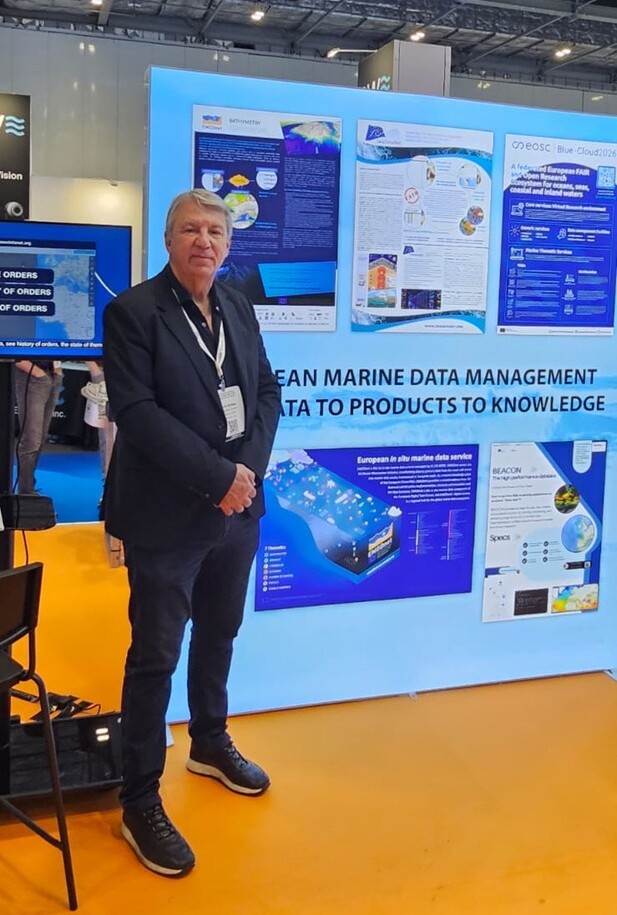
Dick Schaap, managing director of MARIS, and AQUARIUS Work Package 6 Lead on Data Management and Open Science Practices, brought his expertise in European projects and infrastructures, including EMODnet, SeaDataNet, Blue-Cloud 2026, supporting open science in the aquatic domain as part of the European Open Science Cloud and the European Digital Twin Ocean developments. The MARIS stand highlighted a suite of European marine data services, projects, and tools that showcase how European marine data management transforms data into products and, ultimately, into knowledge, including the AQUARIUS Open Data Strategy that strives to make all new acquired observation data together with metadata available in a FAIR way in the European marine data management infrastructures such as SeaDataNet, EurOBIS, Coriolis, and others, which feed into EMODnet and Copernicus Marine, and share with global data repositories and EDITO, the public infrastructure for the European Digital Twin Ocean.
Carlos Barrera, Head of the Ocean Vehicles Unit at the Plataforma Oceánica de Canarias (PLOCAN) and AQUARIUS partner, highlighted opportunities for early-career scientists and technicians, including the PLOCAN Glider Summer School. The PLOCAN test site supports marine robotics, fleets, platforms, underwater gliders, and autonomous vehicles, serving as a unique resource for both the scientific community and the private sector. It was one of the most requested infrastructures in the second AQUARIUS Transnational Access Funding Call.

The MARIS stand at OI 2026, which also featured, EMODnet, SeaDataNet, and Blue-Cloud services, underlined that European marine data management is about building an end-to-end value chain: from fragmented in situ observations, to harmonised data and products, to marine knowledge that supports policy and decision-makers, industry, and society. AQUARIUS was promoted by means of brochures, postcards, stickers, and the leaflet, presenting the Training Opportunities.
The OI 2026 event brought together over 450 exhibitors from across three key ocean pillars—industry, academia, and government—showcasing cutting-edge technologies and solutions that are helping to shape the future of our oceans. It was an opportunity to update on the latest ocean technologies, and exchange ideas with industry to get more understanding of how industry is engaging with ocean and climate challenges that demand ever more innovative solutions.